Can a Handyman Install Hurricane Shutters? (Florida Licensing Guide)
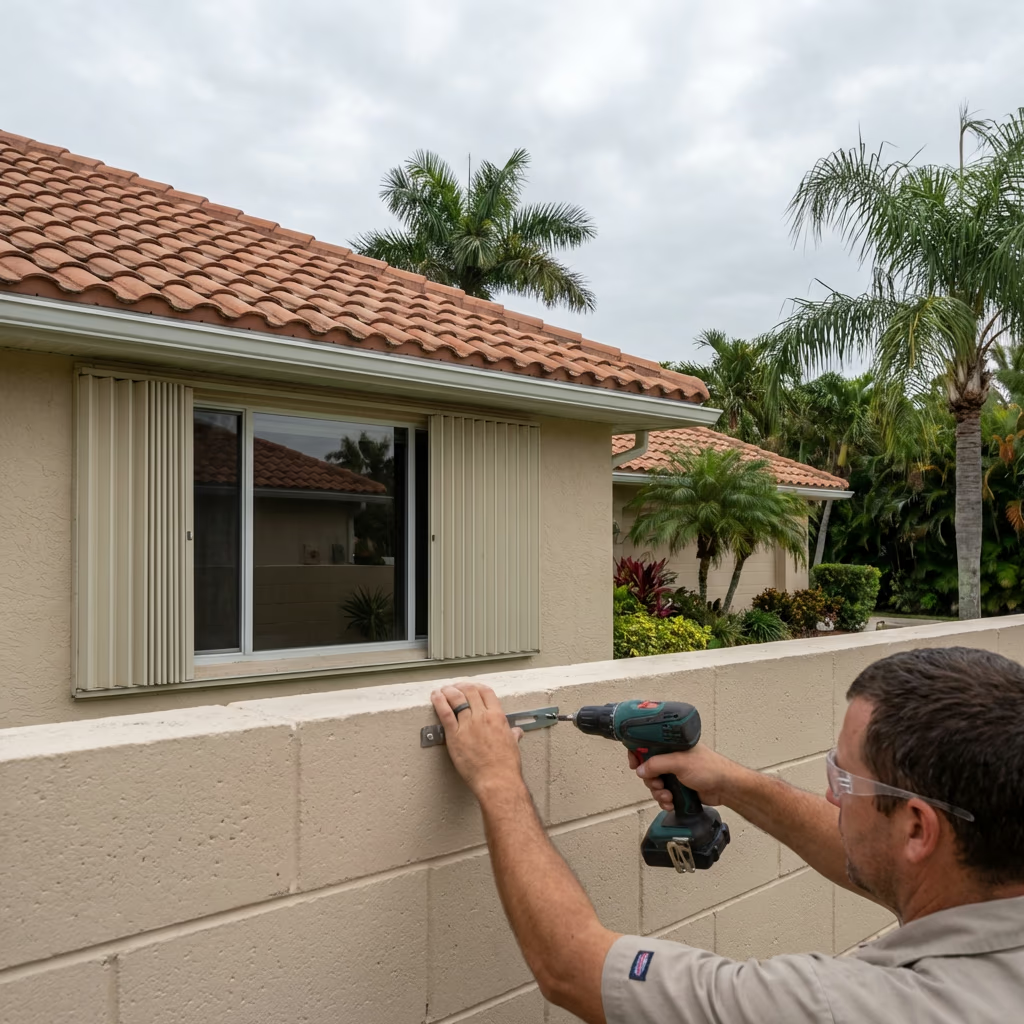
Can a handyman install hurricane shutters in Florida? Yes — if they hold the right license. Florida law requires a Certified Building Contractor (CBC) or Certified Residential Contractor (CRC) license for permanent hurricane shutter installation. An unlicensed handyman cannot pull the building permits most municipalities require, and working without permits can void your homeowner's insurance coverage.
Here's the distinction most people miss: at Chad The Handyman, the word “handyman” describes our business model — one-stop, flexible, efficient — not our licensing level. We hold license CBC-1259887, a Certified Building Contractor license. That's the same license class contractors use to build entire homes. We install, maintain, and deploy hurricane shutters across Estero, Fort Myers, Naples, and Bonita Springs — legally, properly, and with full permit capability.
Below, we break down when a handyman can handle the job, when you need a shutter specialist, permit requirements, real cost ranges, and how shutters affect your insurance premiums. For more on Florida's licensing rules, see our posts on Florida handyman licensing and handyman vs. contractor.
The Short Answer: Yes — If They Hold the Right License
Florida Statute 489 governs who can perform construction and improvement work on residential properties. Hurricane shutter installation falls squarely under this statute. Any permanent shutter system — accordion, roll-down, Bahama, or colonial — requires a building permit in Lee and Collier counties, and only a licensed contractor can pull that permit.
The license types that qualify are CBC (Certified Building Contractor) and CRC (Certified Residential Contractor). A CGC (Certified General Contractor) also qualifies. What does not qualify is an unlicensed worker operating under the handyman exemption. Florida's handyman exemption caps at $1,000 for minor maintenance and repairs — and most shutter installations exceed that by a wide margin.
Our team holds CBC-1259887. We pull permits, schedule inspections, and provide the documentation your insurance company needs. That's the baseline for any hurricane shutter installation done right.
Handyman vs. Shutter Specialist — When You Need Each
A shutter specialist fabricates custom hurricane protection systems. They measure, manufacture, and install custom roll-down shutters with motorized controls, whole-house systems with integrated tracks, and custom-fit products for non-standard openings. If you have a home with arched windows, oversized sliders, or need a custom-fabricated roll-down system, a specialist is the right call.
A licensed handyman covers a different — and often more practical — range of shutter work. We install standard storm panels, accordion shutters, manual and motorized roll-down shutters, Bahama shutters, and colonial shutters. We handle pre-storm deployment of existing systems, post-storm removal and storage, and year-round maintenance. We also repair damaged tracks, replace corroded hardware, and fix accordion shutters that have gone off-track.
Practitioner's note: For custom-fabricated roll-down systems, we refer to a shutter specialist. The fabrication and motor calibration on those units is a different trade. But for everything else — panels, accordions, Bahamas, maintenance, deployment — our general home repair team handles it for 20–40% less than a dedicated shutter company, usually with faster scheduling.
The cost difference is real. A specialist typically charges a premium because shutter fabrication and installation is their entire business. A licensed handyman can often install the same off-the-shelf products for less, and bundle the work with other projects you need done — a window repair, door adjustments, or exterior caulking — all in one trip.
What Types of Hurricane Shutters Can a Handyman Install?
Storm panels are the most handyman-friendly shutter type. These are corrugated aluminum or polycarbonate panels that mount on pre-installed tracks above each window and door opening. Installation is straightforward: mount the header track, mark and install the bolt or wing-nut receivers, and the panels slide into place when a storm approaches. For most homes, a full set of storm panel tracks can be installed in a day. Panels themselves cost $7–$15 per square foot, making them the most affordable permanent protection. If you need window repairs alongside shutter installation, bundling the work saves you a service call.
Accordion shutters fold open at the sides of each window and pull closed along a top and bottom track. Installation requires precise track alignment and secure mounting into the concrete block or stucco surrounding each opening. We install accordions regularly — they're popular in Lee and Collier County because homeowners can close them in minutes without climbing a ladder.
Bahama and colonial shutters serve double duty as architectural features and storm protection. Bahama shutters mount above the window on a hinge and prop open at an angle for shade; colonial shutters mount on either side and swing closed. Both require precise mounting and hardware that can withstand hurricane-force wind loads. We install both types, and they add curb appeal year-round — not just during storm season.
Roll-down shutters are where the line between handyman and specialist matters most. Manual roll-downs use a hand crank, and motorized roll-downs come down at the push of a button. We install both. The exception is a custom-fabricated system built for a non-standard opening, which we refer to a shutter specialist.
Do You Need a Permit to Install Hurricane Shutters in Florida?
For permanent installations — accordion, roll-down, Bahama, colonial, and permanently mounted panel tracks — yes, you need a building permit in both Lee and Collier counties. The permit process confirms that the shutter system meets the Florida Building Code wind-load requirements for your specific wind zone. Southwest Florida falls within the High-Velocity Hurricane Zone in many coastal areas, which means stricter product approval standards.
Removable storm panels that use temporary clips or wing nuts may be exempt from permitting in some municipalities, but the tracks they mount on often do require a permit. The rules vary by jurisdiction, which is one reason working with a licensed contractor matters — we know the local requirements and handle the permit process for you.
Here's the insurance angle most homeowners overlook: shutters installed without a permit may not count toward your wind mitigation credit. If your insurer asks for documentation and you can't provide a permit and inspection sign-off, you lose the premium discount — and in a claim scenario, unpermitted modifications can give your insurer grounds to dispute coverage. Only a licensed contractor can pull the permit. That's not a technicality. It's the difference between protection your insurer honors and protection they won't.
How Much Does Handyman Hurricane Shutter Installation Cost?
Costs break into two categories: deploying shutters you already own, and installing new permanent systems.
Pre-storm deployment of existing storm panels or accordion shutters runs $15–$50 per opening when booked in advance. A typical home with 12–15 openings costs $200–$600 for deployment. That price assumes you're calling us in May or early June, not two days before landfall. Once a named storm enters the Gulf, demand spikes and availability drops to near-zero. We've seen deployment quotes from other providers triple during active storm warnings. Our emergency services team does its best to accommodate urgent requests, but planning ahead saves you real money every time.
New permanent installations range from $2,000–$8,000 for a whole house, depending on shutter type and the number of openings. Storm panels are the most affordable at the low end. Accordion shutters fall in the $3,000–$6,000 range for an average home. Bahama and colonial shutters cost more because of the decorative hardware and per-unit pricing. Specialist companies typically start at $5,000+ for whole-house accordion systems — which means working with a licensed handyman can save you $1,000–$2,000 on the same product.
For a broader look at how handyman pricing works, see our Florida handyman cost guide.
Can You Install Hurricane Shutters Yourself?
For removable storm panels on a single-story home, DIY installation is physically possible. You're mounting header tracks above each window, drilling into concrete block or stucco, and sliding the panels in. If you own a hammer drill, have a helper, and are comfortable on a ladder, you can do it.
But “possible” and “practical” are different things. A typical Florida home has 12 to 20 openings. Each one requires precise measurement, level mounting, and hardware rated for your wind zone. On a two-story home, you're hauling heavy aluminum panels up a ladder in 90-degree Southwest Florida heat. And then there's the permit question: if your municipality requires one for the track installation, you can't pull it yourself.
The practical middle ground: hire a licensed handyman. You get proper permitting, code-compliant installation, and a professional who does this regularly — without the overhead of a dedicated shutter company. For most homeowners, the time, labor, and risk of DIY doesn't pencil out when professional installation starts with a quick phone call and a free estimate.
Hurricane Shutter Maintenance: What a Handyman Can Do Before Storm Season
Shutters sit idle for eleven months, then need to work flawlessly in a Category 3 storm. That only happens with annual maintenance. April or May is the right time — early enough to fix problems before the June 1 season start, late enough that any lubrication or hardware replacement stays fresh.
Here's what we check during a shutter maintenance visit:
- Tracks and channels: Clear debris, dirt, and wasp nests (mud daubers love accordion shutter tracks in Florida). Straighten any bent sections.
- Lubrication: Apply silicone-based spray to all tracks and moving parts. Never use WD-40 — it attracts dirt and gums up over time.
- Corrosion check: Inspect all mounting hardware, bolts, and wing nuts for rust or galvanic corrosion. Salt air in Lee and Collier counties can eat through uncoated hardware in a single season.
- Test deployment: Close every shutter and verify it locks securely. Accordion shutters that bind or skip off-track need adjustment before a storm, not during one.
- Panel inventory: For storm panels, verify every panel is labeled for its opening and accounted for. Missing or damaged panels discovered two days before landfall leave that opening unprotected — and one unprotected opening can cause catastrophic interior damage.
Practitioner's note: We find mud dauber wasp nests inside accordion shutter tracks on roughly one in three homes during spring maintenance. The nests pack the channel with mud that prevents the shutter from closing. A five-minute cleaning in April avoids a panic in August. If you're building a full hurricane prep checklist, put shutter maintenance near the top.
Hurricane Shutters and Insurance: Will They Lower Your Premium?
Florida law requires insurance companies to offer premium discounts for verified wind mitigation features, and hurricane shutters are one of the highest-impact improvements you can make. Shutters that cover all openings — every window, every door, the garage — can reduce the windstorm portion of your homeowner's premium by up to 30%.
The key word is “all.” Partial coverage (shutters on windows but not the garage door) qualifies for a smaller discount or none at all. The insurance company evaluates your home using the OIR-B1-1802 wind mitigation inspection form. A licensed inspector fills out this form, documenting what protection each opening has. If every opening is covered by an approved product, you get the full credit.
The My Safe Florida Home program also offers matching grants — up to $10,000 — for hurricane-hardening improvements including shutter installation. The state matches $2 for every $1 you spend on qualifying upgrades. Combined with the ongoing insurance savings, most homeowners recoup the full cost of shutter installation within two to three years.
We work alongside home inspection report repairs and wind mitigation findings regularly. If your inspection report flags missing opening protection, we can address it alongside other common inspection findings in the same set of visits — shutters, electrical corrections, plumbing items, and exterior repairs all handled by one licensed team.
Need Hurricane Shutters Installed or Serviced?
Our licensed team (CBC-1259887) handles installation, maintenance, and pre-storm deployment across Southwest Florida. Free estimate, no pressure, same-week scheduling.
Licensed (CBC-1259887). Insured. Family-owned since 2010. 475+ reviews at 4.8 stars on Google.
Frequently Asked Questions
Can a handyman legally install hurricane shutters in Florida?
Yes, if the handyman holds a Florida Certified Building Contractor (CBC) or Certified Residential Contractor (CRC) license. Unlicensed handymen cannot pull the required building permits for permanent shutter installations. Always verify your handyman’s license through the Florida DBPR before hiring.
What is the difference between a handyman and a shutter specialist for hurricane shutters?
A shutter specialist focuses exclusively on hurricane protection products and often fabricates custom systems. A licensed handyman like a CBC holder can install standard accordion, panel, and certain roll-down shutters, plus handle maintenance, repairs, and pre-storm deployment — often at lower cost and with the convenience of one contractor for multiple home services.
How much does it cost to have someone put up hurricane shutters before a storm?
Pre-storm deployment of existing shutters typically costs $15–$50 per opening when scheduled in advance. Costs increase significantly when a storm is imminent due to demand. New permanent installations range from $2,000–$8,000 for a whole house depending on shutter type.
Do I need a permit to install storm panels in Florida?
Removable storm panels may not require a permit in all Florida municipalities, but permanent shutter installations (accordion, roll-down, Bahama, colonial) require a building permit in Lee and Collier counties. Check with your local building department, as requirements vary.
Can hurricane shutters save me money on homeowners insurance?
Yes. Florida law mandates insurance premium discounts for wind mitigation features. Hurricane shutters covering all openings can reduce the windstorm portion of your premium by up to 30%. A wind mitigation inspection is required to document the improvement and claim the discount.
When should I schedule hurricane shutter installation or maintenance in Florida?
Schedule new installations or annual maintenance in April or May, before hurricane season begins June 1. Waiting until a storm is in the forecast means contractors are booked solid, costs increase, and you may not find anyone available.