Handyman vs. Contractor: When Do You Need Each?
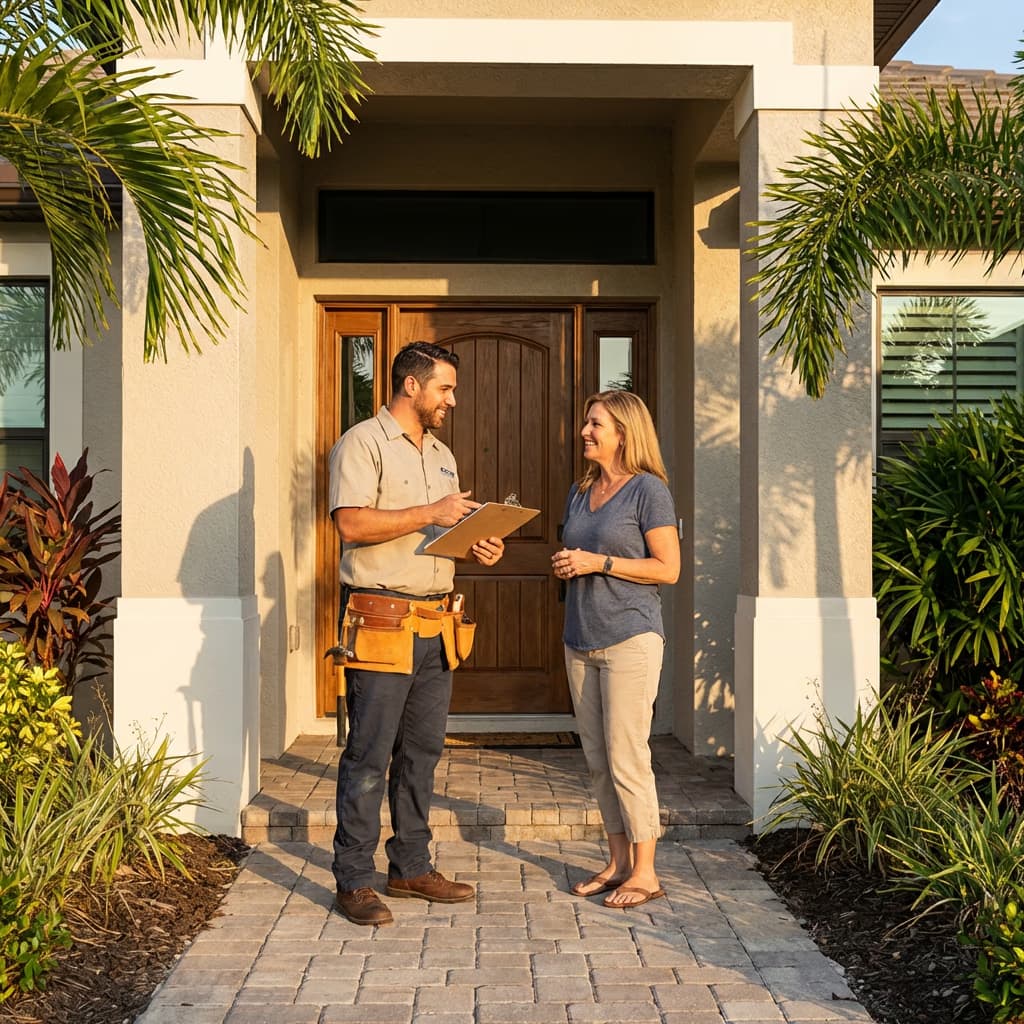
The question comes up constantly — do I need a handyman or a contractor? In Florida, the line is more nuanced than most people think. The real answer depends on what the work involves, how much it costs, and whether the project requires specialized licensing beyond a general contractor's scope.
Most homeowners overpay by calling specialists for work that a licensed handyman handles routinely — and underpay by hiring unlicensed workers for jobs that legally require a licensed professional. We see both sides of this every week at Chad The Handyman, working across Estero, Naples, Bonita Springs, and Fort Myers.
This post breaks down the real differences, explains what falls into each category, and gives you a practical framework for deciding who to call. We're a licensed contractor (CBC-1259887) who operates as a handyman — which puts us in a unique position to explain where the line actually is.
The Real Difference Between a Handyman and a Contractor
Here's something most homeowners don't realize: “handyman” and “contractor” aren't formal legal categories in Florida. The license is what matters. A person calling themselves a handyman might hold the same Certified Building Contractor (CBC) license as someone who builds entire homes. Or they might hold no license at all. The title on the truck tells you nothing — the license number tells you everything.
Under Florida law, an unlicensed person can only perform work totaling less than $1,000 per project. That's total — labor and materials combined. Anything above that threshold requires a licensed contractor. This means the guy from Craigslist who will “do anything around the house” for cash is operating legally only if each job stays under a thousand dollars. The moment the project crosses that line, you're both exposed — the worker to criminal charges for unlicensed contracting, and you to voided insurance coverage and zero legal recourse if the work goes wrong.
A licensed handyman like Chad The Handyman holds a CBC license (CBC-1259887). That's the same class of license held by contractors who build custom homes and do major renovations. The practical difference isn't about capability — it's about approach. Handymen are generalists who handle a wide range of trades in a single visit: electrical, plumbing, drywall, carpentry, painting, exterior work, and more. Specialist contractors focus on one trade — roofing, HVAC, plumbing, or electrical — and bring deep expertise in that specific area.
The takeaway: always ask for a license number before hiring anyone. Verify it at myfloridalicense.com. For more on Florida's licensing requirements, see our post on whether handymen in Florida need a license.
What a Licensed Handyman Handles
The biggest advantage a licensed handyman offers is the multi-trade skillset. One professional who can do electrical work, plumbing repairs, drywall patching and texture matching, carpentry, painting, exterior repairs, and more — all in a single visit. That versatility is the core value proposition and the reason most of our clients call us instead of juggling multiple specialists.
The list of common handyman tasks is longer than most people expect: ceiling fan installation, GFCI outlet upgrades, faucet replacement, toilet repair, garbage disposal installation, drywall patching with texture matching, door adjustments and hardware replacement, screen replacement, hurricane shutter installation, interior and exterior painting, caulking, fixture installation, smoke detector replacement, and general maintenance work. Visit our general home repairs page for the full service list, or see our dedicated pages for electrical services and plumbing repair.
The efficiency factor is where the math really works in your favor. Instead of scheduling four different specialists — an electrician for the ceiling fan, a plumber for the faucet, a drywall contractor for the patches, and a general handyman for the odds and ends — one licensed handyman knocks out your entire to-do list in a single morning. One trip fee instead of four. One invoice instead of four. One point of contact instead of four.
Here's what a typical handyman visit looks like: a homeowner might get a ceiling fan installed in the master bedroom, two GFCI outlets upgraded in the kitchen and bathroom, a bathroom faucet replaced, and three door handles swapped out — all in one trip. That's four different trade categories addressed by one team in a few hours. Try scheduling that with individual specialists and you're looking at four separate appointments spread across two to three weeks.
Practitioner's note: The homeowners who get the most value from a handyman visit are the ones who bring their full list. Don't call us for one ceiling fan and then call back next week for a faucet. Give us everything at once — we'll knock it all out in one visit and save you real money compared to piecemeal scheduling.
When You Need a Specialist Contractor
We're going to be straight with you about what's outside our scope. Part of being trustworthy is knowing where your lane ends and being honest about it. There are projects that genuinely require a specialist, and sending you to the right professional is part of the service we provide.
Roofing: Full roof replacement or major structural roof repairs require a licensed roofing contractor holding a CCC (Certified Roofing Contractor) license. A general contractor's CBC license doesn't cover roofing work above a certain scope. That said, we handle everything adjacent to the roof — damaged fascia boards, rotted soffit panels, interior water damage after the roof is fixed, and flashing repairs at wall-to-roof transitions. Once the roofer does their part, we come in and handle the rest.
HVAC: Full system replacement — a new air handler and condenser unit — requires a licensed HVAC contractor. Florida's AC systems run harder than anywhere else in the country, and when the system dies, you need a specialist who handles refrigerant, electrical connections at the panel level, and ductwork modifications. We handle the items around the HVAC system: thermostat replacement, condensation drain line maintenance, and minor ductwork repairs. See our air conditioning repair page for what we do handle.
Full re-plumbing: A whole-house re-pipe — especially polybutylene pipe replacement, which is common in Southwest Florida homes built between the late 1970s and mid-1990s — requires a licensed plumber. The scope, permitting, and specialized knowledge involved go beyond a general contractor's typical work. We handle all fixture-level plumbing: faucets, toilets, shut-off valves, garbage disposals, and supply line connections.
Other specialist territory: Structural work like foundation repairs and load-bearing wall modifications requires a structural engineer and specialized contractor. Electrical panel upgrades — adding new circuits or upgrading the panel itself — requires a licensed electrician. Any work involving natural gas lines requires specific licensing. Swimming pool equipment installation and repair requires a pool contractor.
Practitioner's note: Here's the rule of thumb we use: if the project involves a single major system that needs complete replacement, you likely need a specialist. If the project involves repairs, upgrades, or maintenance across multiple trades, a licensed handyman is the more efficient and cost-effective choice.
Cost Comparison: Handyman vs. Specialist Contractor
Let's talk numbers, because this is where the decision gets practical. Specialist contractors — electricians, plumbers, drywall contractors — typically charge a trip fee of $100 to $200 per visit just to show up. Then they bill hourly or project rates on top of that. The trip fee exists because a specialist is dedicating a truck, tools, and a technician to your location, and they need to cover that overhead whether the job takes twenty minutes or two hours.
Now consider what happens when you have five small tasks across different trades. Calling five specialists means five trip fees ($500-$1,000 before anyone turns a wrench), five scheduling windows to coordinate, and five half-days spent waiting at home. A licensed handyman handles all five in one visit with one trip fee. The savings aren't marginal — they're significant.
Here's a scenario we see regularly: a homeowner needs a ceiling fan replaced, a kitchen faucet swapped out, and a few drywall patches repaired and painted. Calling an electrician for the fan runs $150-$300 after the trip fee. A plumber for the faucet runs $200-$400 after the trip fee. A drywall contractor for the patches runs $150-$300 after the trip fee. That's $500-$1,000 in trip fees alone before any actual work begins, and a total of $500-$1,000+ just in overhead. A handyman does all three in one visit, saving you the redundant trip fees and the hassle of coordinating multiple schedules.
The exception matters too: for large, single-trade projects — a full kitchen remodel, a roof replacement, a complete HVAC installation — a specialist's dedicated expertise and crew are worth the premium. Their deep focus on one trade means they've done the exact same project hundreds of times. For those big jobs, the specialist is the right call. For detailed pricing information on handyman services, see our guide on how much a handyman charges per hour in Florida.
The Home Inspection Scenario: Where Handymen Shine
If there's one scenario that perfectly illustrates the handyman advantage, it's the home inspection report. This is the single situation where a licensed handyman outperforms calling multiple specialists by the widest margin — in cost, speed, and simplicity.
A typical home inspection report in Southwest Florida lists 15 to 25 items spread across electrical, plumbing, drywall, exterior, safety, and miscellaneous categories. If you try to address each category by calling the appropriate specialist, you're looking at four to six different contractors, four to six scheduling windows, four to six invoices, and two to three weeks just to coordinate everyone. Each specialist handles their narrow slice and moves on, leaving you to manage the rest.
A licensed handyman handles 80-90% of a typical inspection report in one to two visits. GFCI outlets, smoke detectors, plumbing fixtures, drywall patches, door adjustments, fascia and soffit repairs, caulking, screen replacements, safety items — all addressed by one team, documented on one invoice, with one set of completion photos for the closing file. When you're working against a closing deadline — and we work around closing dates every single week — that efficiency isn't just convenient. It's the difference between closing on time and requesting an extension.
The few items that typically need a specialist — a roof that's at end of life, a full HVAC replacement, a polybutylene re-pipe — get referred out while we handle everything else in parallel. The result: your entire report is addressed in days, not weeks. Visit our home inspection report repairs page to see the full scope of what we handle. For more on which tasks fall within a handyman's scope, see our post on what tasks a licensed handyman can do in Florida.
How to Choose the Right Professional for Your Project
Choosing between a handyman and a specialist doesn't have to be complicated. Here's the framework we recommend to every homeowner who asks.
Step 1: Ask for a license number. Before anything else — before discussing price, timeline, or scope — ask for their license number. Verify it at myfloridalicense.com. If they don't have one, or if they get defensive when you ask, that tells you everything you need to know. In Florida, any contracting work over $1,000 requires a license. Period.
Step 2: Ask for proof of insurance. A legitimate contractor carries general liability insurance and workers' compensation coverage. If a worker is injured on your property and they don't have workers' comp, your homeowner's insurance may be on the hook. Ask for certificates of insurance — any professional who carries them will hand them over without hesitation.
Step 3: Consider the scope. Look at your project list. Is it a multi-trade to-do list with items across several categories? That's handyman territory. Is it a single major system that needs complete replacement or a complex installation? That's specialist territory. Most homeowners fall into the first category more often than they think.
Step 4: Get written estimates. Never accept verbal quotes for significant work. A written estimate protects you and sets clear expectations. It should itemize the work, specify materials, and include a timeline. Any contractor who won't put their quote in writing is not someone you want working on your home.
Step 5: Check reviews. Google reviews are the most transparent indicator of how a contractor actually performs. Look for volume (anyone can get a handful of five-star reviews from friends) and consistency. Read the negative reviews too — how a contractor responds to criticism says as much as the praise.
Step 6: Trust your instincts. A professional who is transparent about what they can and can't do is more trustworthy than one who says yes to everything. If a handyman tells you a project is outside their scope and refers you to a specialist, that's a handyman you can trust with the work that is within their scope. We serve Estero, Naples, Bonita Springs, and Fort Myers — see our Bonita Springs handyman services page for more on how we work in your area.
Not Sure Whether You Need a Handyman or a Contractor?
Send us your project details or your home inspection report. We'll tell you exactly what we handle, what needs a specialist, and give you a clear estimate for our portion — no obligation.
Or send us your project details for a free estimate.
Licensed (CBC-1259887). Insured. Family-owned since 2010. 475+ five-star reviews.
Frequently Asked Questions
Is a handyman the same as a contractor in Florida?
Not exactly. In Florida, the distinction is about licensing, not title. An unlicensed handyman can only perform minor work under $1,000 total per project. A licensed handyman who holds a CBC (Certified Building Contractor) or CGC (Certified General Contractor) license can perform the same range of work as any licensed contractor. The practical difference is that handymen are typically generalists who handle multiple trades in one visit, while specialist contractors focus on a single trade like roofing, plumbing, or HVAC.
When should I call a handyman instead of a contractor?
Call a handyman when you have a list of small to medium tasks across multiple categories — electrical, plumbing, drywall, painting, doors, screens, and general repairs. The handyman handles everything in one visit, saving you multiple trip fees and scheduling headaches. Call a specialist when the project involves a single major system replacement (roof, HVAC, full re-pipe) or requires trade-specific licensing that goes beyond a general contractor’s scope.
Is it cheaper to hire a handyman or a contractor?
For multi-trade to-do lists, a handyman is almost always more cost-effective. You pay one trip fee instead of several, and the work is done in fewer visits. For large single-trade projects, a specialist’s focused expertise and dedicated crew may provide better value. The most expensive option is usually calling multiple specialists for small tasks that a single handyman could handle in one morning.
Can a handyman do electrical and plumbing work in Florida?
A licensed handyman with a CBC or CGC license can handle electrical and plumbing work on existing systems — outlet replacements, GFCI upgrades, ceiling fan installation, faucet replacement, toilet repairs, garbage disposal installation, and similar tasks. Work that involves new circuit installation, panel upgrades, or full system replacement typically requires a trade-specific specialist. Our CBC-1259887 license covers the full range of residential repair and maintenance work.
How do I know if my project needs a specialist?
As a general rule, if the project involves a complete system replacement (new roof, new HVAC system, whole-house re-pipe), structural modifications (removing load-bearing walls, foundation repair), or gas line work, you need a specialist. If the project involves repairs, replacements, or upgrades to existing systems across multiple trades, a licensed handyman is typically the right call. When in doubt, a reputable handyman will tell you honestly if a project falls outside their scope.