Licensed vs. Unlicensed Handyman in Florida: What's Really at Risk
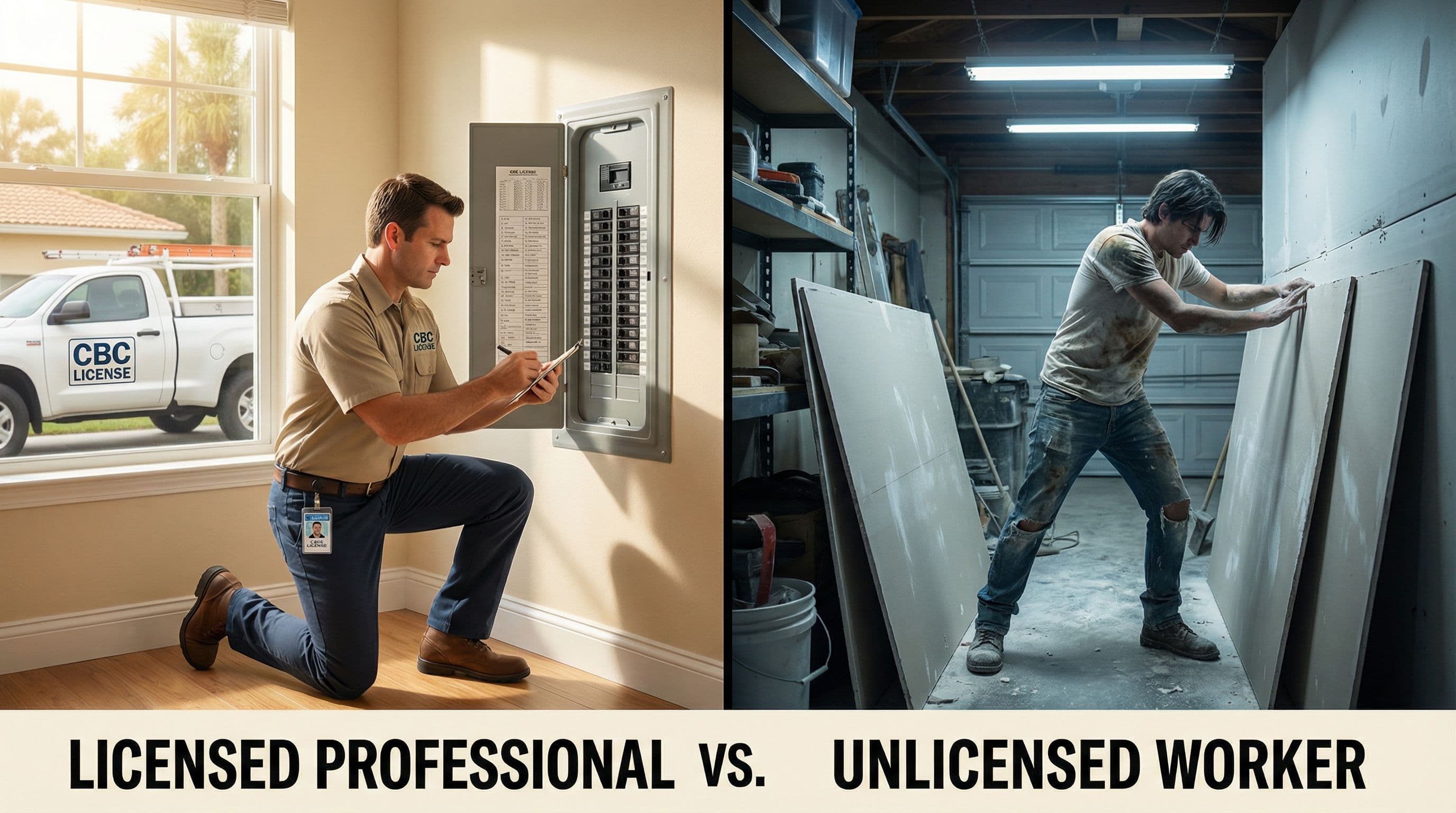
Quick answer
In Florida, an unlicensed handyman can legally do minor work under $1,000 in combined labor and materials — painting, hanging shelves, pressure washing. Anything involving electrical, plumbing, structural work, permits, or projects over $1,000 requires a licensed contractor. The real cost of hiring unlicensed isn't the labor rate — it's denied insurance claims, worker-injury liability, and complications when you sell your home.
Hiring in SW Florida? Our license is CBC-1259887 — verify it at myfloridalicense.com, then call (239) 880-2423 or get a free quote.
Nobody thinks about licensing when they're hiring a handyman. They think about price, availability, and whether the person seems trustworthy. The licensing question comes up later — usually when something goes wrong.
We hold a State of Florida Certified Building Contractor license (CBC-1259887). We've held it since we started this business in 2010. And we regularly get called to fix work done by unlicensed operators — work that looked fine on the surface but failed when it mattered. Electrical that wasn't up to code. Plumbing that leaked inside walls for months before anyone noticed. Shutter brackets that pulled out of the stucco because they missed the structural anchoring points.
This isn't a scare piece. Unlicensed handymen are perfectly fine for genuinely minor work. But the line between “minor” and “you needed a licensed contractor for that” is thinner than most people realize. And the consequences of getting it wrong fall entirely on you, the homeowner.
Licensed vs. Unlicensed at a Glance
Before the details, here's the practical difference between hiring licensed and unlicensed in Florida:
| Licensed Contractor | Unlicensed Handyman | |
|---|---|---|
| Insurance claims | Covered | May be denied |
| Building permits | Can pull permits | Cannot pull permits |
| Contract disputes | DBPR + courts | Small claims only |
| Worker injury | Workers' comp covers it | Homeowner may be liable |
| Home resale | Documented, permitted | Complications at closing |
| Project size | No limit | Under $1,000 only |
| Regulatory oversight | DBPR monitors | No oversight |
That table tells the story. A licensed contractor costs a little more per hour. But you're paying for insurance coverage, legal protection, and documentation — not just labor.
What Actually Happens When Unlicensed Work Goes Wrong
This isn't hypothetical. We see the aftermath in homes across Estero, Naples, Fort Myers, and Bonita Springs regularly. Here are the patterns.
The insurance denial. Homeowner hires an unlicensed operator to install a water heater. Six months later, a supply line fitting fails and floods the garage. Insurance adjuster asks for the contractor's license number and permit documentation. Neither exists. Claim denied. The homeowner pays for the water damage out of pocket — plus the cost of having the water heater reinstalled correctly by a licensed plumber.
The injury liability. Unlicensed worker falls off a ladder while cleaning gutters. No workers' compensation coverage. The homeowner's property becomes the injury site, and the homeowner's insurance gets dragged into the medical bills. This is real exposure. Licensed contractors carry workers' comp — it's required for licensure in Florida.
The failed inspection. An unlicensed handyman installs hurricane shutter brackets. Looks fine on the outside. But the anchors missed the structural blocking inside the wall and went into stucco only. First real windstorm, those shutters pull free — taking chunks of exterior wall with them. The homeowner thought they were protected. They weren't.
The deal-killer at closing. Home goes under contract. Buyer's inspector flags work that wasn't permitted. Title company asks for documentation. None exists. Now the seller has to pay for a licensed contractor to redo the work, pull proper permits, and pass inspection — all while the buyer is threatening to walk. We get calls like this from realtors across Lee and Collier counties every month.
Practitioner's note: The most common unlicensed work we get called to fix involves electrical (wrong wire gauge, no GFCI protection, circuits overloaded), plumbing (improper fittings, missing shut-off valves), and exterior work (shutter brackets in stucco instead of structural members, fascia attached to rotted wood). The repair usually costs more than the original job would have — because now we're fixing damage on top of doing the work correctly.
The Insurance Problem Most Homeowners Don't Know About
This is the risk that catches people off guard. Most homeowner's insurance policies require that work be performed by licensed contractors. Not “prefer” — require.
When your insurance company discovers that damage resulted from work done by an unlicensed person, they have grounds to deny the claim entirely. In some cases, they can use it as cause to review your policy — not just the specific claim, but your coverage as a whole.
The scenario plays out like this: an unlicensed handyman does electrical work in your bathroom. The wiring isn't up to code. Months later, moisture gets into the junction box and causes a short. You file a claim. The adjuster investigates and finds no permit on record for the electrical work. No license number on the invoice. Claim denied. You're on the hook for the repair and whatever damage the short caused — smoke damage, water damage from the fire suppression, replacement of affected fixtures.
Then there's the worker injury question. If an unlicensed handyman is injured on your property and they don't carry workers' compensation (most unlicensed operators don't), you as the property owner can be held liable for their medical costs. A licensed contractor in Florida is required to carry workers' comp — their coverage handles injuries, not yours.
When You Sell Your Home, the Truth Comes Out
Southwest Florida has a hot real estate market, and transactions here are thorough. Buyers hire inspectors. Title companies check permits. Lenders require documentation. And home inspection reports flag everything.
Unpermitted or undocumented work creates problems at every stage of a sale:
- Inspection findings. Inspectors can often tell when work was done by someone who didn't know code requirements. Electrical panels wired incorrectly, plumbing connections using wrong materials, structural modifications without engineering. These get flagged and become negotiation points.
- Missing permit records. Lee County and Collier County maintain permit databases that buyers and title companies check. If work was done that should have been permitted but wasn't, the seller typically has to resolve it before closing — at their expense.
- Appraisal impact. Undocumented work can lower appraised values. An appraiser who sees unpermitted modifications may discount the home's value to account for the cost of bringing the work up to code.
- Deal-breakers. Some buyers walk away entirely when they discover significant unpermitted work. The risk isn't worth it to them — especially if they're financing and the lender has concerns.
We handle home inspection report repairs for buyers and sellers throughout Southwest Florida. A significant portion of that work involves correcting issues created by previous unlicensed work — work that now needs to be done right, permitted, and inspected before the sale can close.
The Cost Myth — Licensed Isn't as Expensive as You Think
This is the biggest misconception. Most homeowners assume licensed contractors charge significantly more than unlicensed operators. The real gap is smaller than you'd expect.
In Southwest Florida, licensed contractors typically charge $65–$125 per hour. Unlicensed operators usually quote $40–$75. On a typical half-day job, that difference might be $100–$200. Not nothing — but not the dramatic price gap most people imagine.
Now consider what that extra $100–$200 buys you:
- Insurance coverage if something goes wrong
- Valid permits that protect your home's resale value
- DBPR oversight — a regulatory body you can file complaints with
- Workers' comp coverage (their injuries are their problem, not yours)
- Enforceable warranties on the work
- Documentation that satisfies inspectors, title companies, and insurance adjusters
And consider the cost of unlicensed work going wrong. A denied insurance claim for water damage can easily run $10,000–$30,000. Bringing unpermitted work up to code for a home sale adds thousands to closing costs. Worker injury liability has no ceiling. The $100 you saved on the handyman rate starts looking like bad math.
For a full breakdown of handyman pricing in our area, see our guide to handyman costs in Southwest Florida.
Practitioner's note: We quote by the project, not by the hour, for most jobs. A homeowner with a list of five or six tasks often finds our total price is comparable to an unlicensed operator's — because we're efficient. One crew, one trip, everything knocked out. No going back and forth. No coordination headaches. The price difference shrinks when you compare apples to apples.
When You Don't Need a Licensed Contractor
We're not going to pretend every task in your house needs a license. That wouldn't be honest, and honesty is the whole point of this article.
For genuinely minor work under the $1,000 threshold — tasks that don't involve electrical, plumbing, structural components, or permits — an unlicensed handyman can legally do the job. Examples:
- Interior and exterior painting
- Hanging shelves, mirrors, curtain rods, and blinds
- Replacing cabinet hardware (knobs, pulls, hinges)
- Pressure washing driveways and walkways
- Basic caulking and weather stripping
- Furniture assembly
- Mounting a TV on the wall (as long as no electrical work is involved)
But here's where homeowners get tripped up: a morning's worth of “minor” tasks adds up fast. Replace a few outlets, patch some drywall, install a ceiling fan, swap a light fixture — you've crossed $1,000 in labor and materials without trying hard. And several of those tasks involve electrical work that requires a license regardless of cost.
For the full legal breakdown — the $1,000 threshold, the $2,500 disclosure requirement, HB 735, and what the handyman exemption actually covers — read our detailed guide: Do handymen in Florida need a license?
How to Verify a Florida Contractor's License in 2 Minutes
This is the easiest due diligence you'll ever do, and it's free.
Go to myfloridalicense.com — the official DBPR verification tool. Search by name, license number, or business name. Check three things:
- Status — should read “Current, Active”
- License type — Certified (statewide) or Registered (local)
- Complaints — check for disciplinary actions on file
Our license number is CBC-1259887. Look it up right now if you want. We tell every customer to verify — not because we're worried about what they'll find, but because checking should be a habit before hiring anyone. Any contractor who hesitates when you ask for their license number is telling you something.
For a more detailed walkthrough of the verification process, see our Florida handyman licensing guide. It includes screenshots of what to look for and what red flags to watch for.
The Bottom Line for Southwest Florida Homeowners
The decision framework is straightforward:
- Truly minor, cosmetic tasks under $1,000 — painting a room, hanging shelves, pressure washing — an unlicensed handyman is fine.
- Anything involving electrical, plumbing, structural, or permits — you need a licensed contractor. Full stop. The cost difference doesn't justify the risk.
- Any project over $1,000 — Florida law requires a licensed contractor. This isn't optional.
- Anything that could affect insurance claims or resale — use licensed. The documentation alone is worth the price difference.
For more on the handyman vs. contractor distinction, we break down specific scenarios and cost comparisons in a separate guide.
And if you're prepping your home for hurricane season — shutters, screens, roof inspections, garage door reinforcement — that work absolutely requires a licensed contractor. See our hurricane prep checklist for the full rundown.
Need a Licensed Handyman in Southwest Florida?
We hold Florida Certified Building Contractor license CBC-1259887. Verify it yourself at myfloridalicense.com. One call handles everything on your list — electrical, plumbing, drywall, doors, screens, shutters, and more.
Family-owned since 2010. 475+ five-star reviews. Serving Estero, Fort Myers, Naples, and Bonita Springs.
Frequently Asked Questions
Is it illegal to hire an unlicensed handyman in Florida?
Florida law doesn’t penalize homeowners for hiring unlicensed workers. The penalties fall on the unlicensed person performing the work. However, the homeowner bears all the practical consequences: denied insurance claims, liability for worker injuries, unenforceable contracts, and complications when selling the home. The law protects you from criminal liability but not from financial risk.
What is the penalty for unlicensed contracting in Florida?
For the contractor, unlicensed contracting is a first-degree misdemeanor punishable by up to one year in jail and a $1,000 fine. Repeat offenders face felony charges. The DBPR actively investigates complaints. For the homeowner, the consequences are indirect but often more expensive: voided insurance coverage, no regulatory recourse for bad work, and personal liability for on-site injuries.
What is the handyman exemption in Florida?
Florida Statute 489.103(9) exempts minor repair and maintenance work from contractor licensing when the total project value — labor plus materials — stays under $1,000. The exemption does not cover electrical, plumbing, structural, roofing, or any work requiring a permit. It also cannot be circumvented by splitting a larger project into smaller invoices. For a detailed breakdown, see our guide on Florida handyman licensing requirements.
How much more does a licensed handyman cost than unlicensed?
In Southwest Florida, the price difference is typically 10–20% for comparable work. Licensed contractors in our area charge $65–$125 per hour. Unlicensed operators often quote $40–75. But the gap narrows when you factor in what licensed includes: valid insurance coverage, permit-ready work, enforceable warranties, DBPR recourse, and documentation that protects your home’s resale value.
What construction work can a handyman do without a license in Florida?
Under the $1,000 exemption, unlicensed handymen can perform minor tasks like interior painting, hanging shelves, replacing cabinet hardware, pressure washing, basic caulking, and assembling furniture. Anything involving electrical, plumbing, structural modifications, roofing, or HVAC requires a licensed contractor regardless of the project cost.
Do I need a permit for handyman work in Florida?
It depends on the scope. Minor cosmetic work — painting, hardware replacement, patching small drywall holes — generally does not require a permit. But electrical work, plumbing modifications, structural changes, window or door replacements, and roofing repairs typically do. Only a licensed contractor can pull building permits in Florida. If your project needs a permit and the person doing the work can’t pull one, that’s a red flag.